Showing posts with label snow. Show all posts

Thursday, March 21, 2019

Night Equals Day

Yesterday we were treated to the unusual intersection of vernal equinox and a full moon. Here was a nice moment when hours of sunshine were balanced by hours of - wait - moonshine? Let's say moonlight, rather. If you follow your horoscope (and if you don't) this coincidence of full moon and equinox means no more than an interesting astronomical curiosity in your life.

I am guilty of neglecting regular posts for most of the last year, but I'll try again to stay more up to date.

It's been a strong winter in the Sierra, with much more than average snowpack on the ground. It seems like we've had just one week without a storm since the end of January. As in other recent years, the snowline is higher than the historic average although Yosemite Valley got some heavy storms in February that damaged a lot of trees and the buildings beneath them. The Merced is running above average and the waterfalls are all at healthy volumes. Here's hoping for a gradual warming of spring that'll have the falls flowing well through the summer, instead of draining snowfields in a short burst.
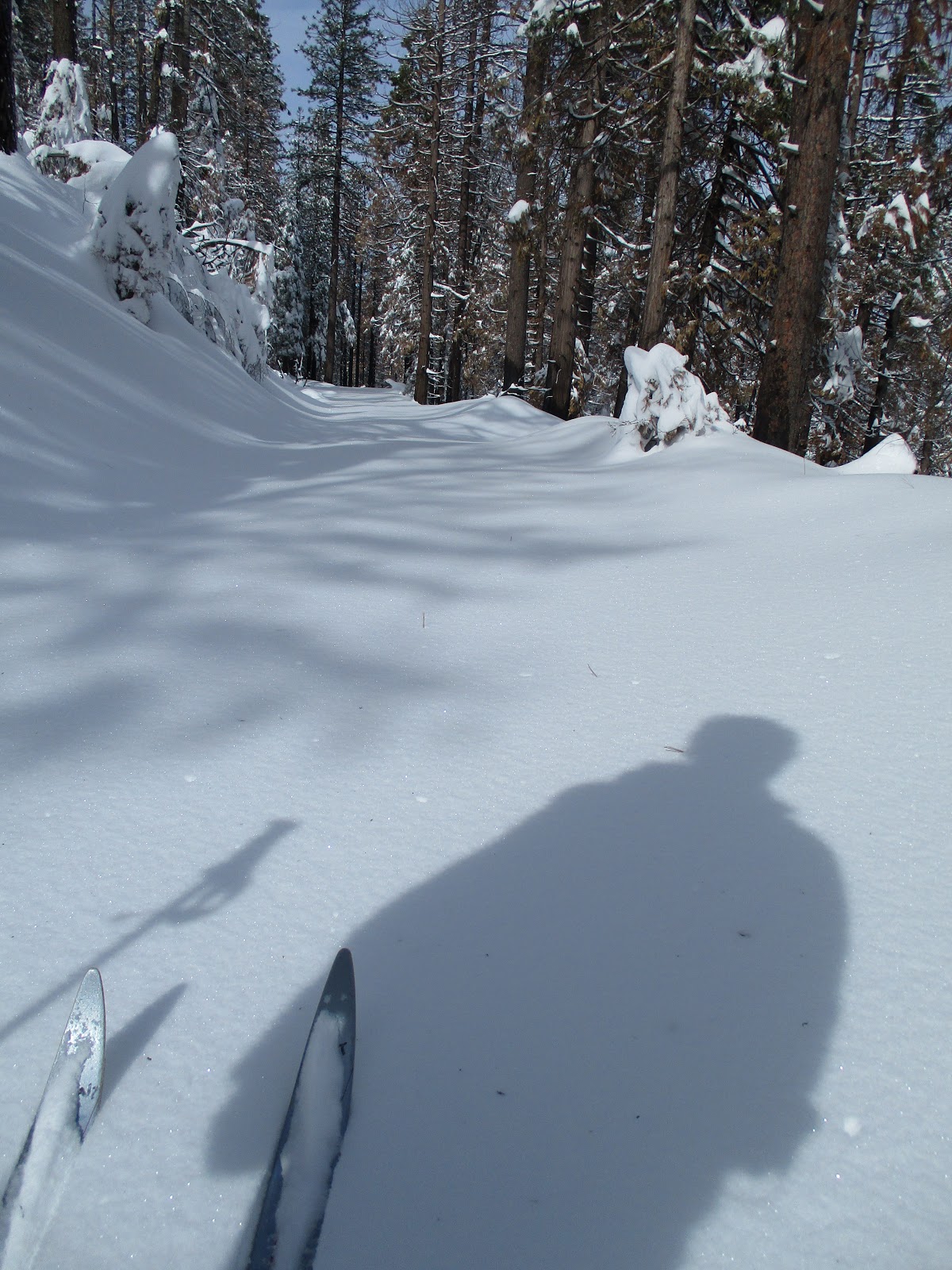
The burned area of last summer's Ferguson Fire (shown here with a skier) has shed a bit of sediment (mostly from the South Fork) in storms but nearly all of that fire was of low intensity and is greening up nicely now. For all the rain and runoff we've had, there wasn't much intense rainfall and we haven't had the rockfalls along Hwy. 140 that we worried about. Not many trees were killed by that fire (lots of already dead trees didn't even burn) and the forest is healthier for it. Burned or not, as with much of California, it's looking like a good wildflower season. Kumlienia started in January, and the rocky banks that were cooked black in August are now coated in greenery and flowers. Poppies, popcorn flower, baby blue-eyes and fiddlenecks are already at photogenic quantities in the Merced Canyon, but are still densifying toward their peaks.

I am again leading trips to Yosemite's sister national parks in China. Mountain Travel Sobek has us headed to explore the natural and cultural history of Jiuzhaigou and Huangshan and to meet with park rangers to learn about China's park management. Hiking in both parks is truly astounding and I can't wait to get back there.

Monday, April 3, 2017

Post-winter Recovery

Springtime is making its way uphill in the Sierra with redbud peaking in El Portal now while unfathomable snow persists above 7000 feet. It can hardly be said enough: WHAT a winter we've had here! Storms were repeated with good frequency and lots of Pacific moisture, leaving us with a tremendous snowpack. The snowline was a bit higher than historical averages; not much accumulated in Yosemite Valley (though we had lots of rain runoff), but higher elevations have had fantastical quantities. The central Sierra has 175% of usual water content in the current snowpack. Picture the meadows and forests in the May Lake area buried by 6-7 feet of water (not 6' of snow, but 6' of standing water) - that's the nature of how much mature, dense snow is covering the tens of thousands of acres of Yosemite's upper elevations.

<-Bridalveil in flood.

Storm damage has been considerable in/near the park, with Hwy. 41 having been closed for a month by a washout, and crews working hard to repair slope movement on the Big Oak Flat Road below Crane Flat in hopes of getting it re-opened before Memorial Day. Trails at and above the Yosemite Valley level have a lot of downed trees; trail crew sawyers will be very busy for much of the summer to get those cleared. When you visit the Valley, check out the fragments of bark-less logs below Bridalveil or Yosemite Falls from trees that were uprooted and thrown over the falls this winter. Since December there's been a huge deposit of frazil (wist) ice below Yosemite Falls, and we're now in the month when one is most likely to be able to observe wist ice flowing.

The excitement isn't over. Because of the closure of the Big Oak Flat Road, Hwy. 140 has been handling much more traffic. This past Saturday, visitors were waiting over 2 hours in a 3.5 mile-long line of 800+ cars just to get through the stoplight at the Ferguson rockslide detour west of the park. (Easily avoided by coming in before 9am on weekends.) Because of the road construction in the Valley, the main parking at Yosemite Village will be closed for the next two months, and detours are confusing to both new and veteran visitors. It's going to be a very nice improvement once it's completed, but parking and navigating can be challenges on spring weekends now. Half Dome Village and the new lot by Camp Four are best bets. The road crew is already working to clear Glacier Point Road.

But, wait, there's more. The Merced is running almost 4x average flow today. All that snow in the high country seems likely to bring us some degree of 'high water incident' between now and mid-June (sure to cover some Valley trails at least), depending on how the warming progresses. Yosemite explorers should expect a delayed start to summer, with Tioga Road opening late, trails covered by snow and fallen trees, and creeks difficult to cross.

Saturday, January 28, 2017

Ice, Ice, Maybe

There's an exceptional accumulation of waterfall slurry ice below Yosemite Falls right now, and the whole amphitheater is closed for safety reasons. The stream of 'frazil' flow meanders dynamically and it'd be possible for someone to get into real trouble with this unstable landscape. We know it's not really 'frazil ice' because this slurry is formed of frozen waterfall mist/droplets, but it's remarkable, whatever we call it.
There's frazil deposition in Royal Arch Creek and Steve B. says there's frazil in Bridalveil and Ribbon Creeks.

There's also a very healthy snowpack at higher elevations, well above average in depth and water content. The Valley has lots of water from recent storms; there's almost a foot of snow on the ground but running water in Sentinel, Eagle, Royal Arch, Ribbon and other creeks. This wet winter bodes well for summertime waterfalls, some groundwater recharge, and perhaps a more normally-timed start to the fire season. We'll have to wait a few months to fully assess the end of the drought.

Meanwhile at lower elevations flowers are blooming in the Merced River canyon: fiddleneck, baby blue eyes, and a galaxy of waterfall buttercups can be found.

Tuesday, May 15, 2012

Farewell to Spring


Despite recent warmth, the Merced River has started to decline in volume already; it's running just below average (while the average is still ascending). We are excited to have our new webcam up, showing you Upper Yosemite Falls so you can keep visual tabs on the flows. We expect that by September this year it'll just be the 'Yosemite Wall' webcam.
Indian, Sentinel, Royal Arch and Ribbon Creeks all still run to the river. Eagle Creek has shrunk back from Northside Drive.
The high country along Tioga Road still has snow, lots of soggy trails, no new greenery - it's too early for dry, comfortable hiking that won't leave considerable impacts. People tend to hike outside wet trailbeds, creating new trails and crushing plants as they're trying to get started. Things will be drier in June and it'll be easier to LNT.
Yosemite Valley is alive with birdsong; yesterday's birdwalk included black-headed grosbeaks (plentiful and loud), western tanager, yellow, yellow-rumped, and black-throated gray warblers, Cassin's vireo, white-throated swift, flicker, oriole, Anna's hummingbird displaying in front of the Visitor Center, and more.
In the El Portal area the Clarkia (Farewell-to-Spring) is in bloom, as is buckeye, Ceanothus, and elderberry. Most of the grass and forbs have gone to seed and are browning. The dogwoods in the Valley are glorious right now.
Check out the eclipse of the sun on Sunday at sunset. We were not sure that Yosemite would be a good place from which to observe this spectacle because good western views from places like the Glacier Point Road might not yet be accessible; this year they are. Crane Flat Fire Lookout and Sentinel Dome will be prime spots.
For more enjoyment of the earth sciences: there's still space in our one-day geology course on June 16. Park geologist Greg Stock is a marvelous communicator and will clarify all those questions you have about Yosemite's origins.

Thursday, March 15, 2012

Vernal Equinox


Equinox arrives next week, when day length matches nighttime. Though they were closest on Monday night, it's still worth getting out in the evening to see the close positioning of Venus and Jupiter. They're a bright pair, impossible to miss as long as you have a view to the west for an hour or two after sunset. (You can actually see Venus with the naked eye all day, too, if you know where to look in the blue sky.) Though smaller than Jupiter, Venus is the more brilliant because it is closer to Earth.
Light precipitation off/on in Yosemite this week, with snow level remaining above the rim so far. We expect snow on the Valley floor this weekend. In the Merced Canyon below the park boundary, greenery is soaking up the moisture; great numbers of flowers are in bloom. Dense poppies cover the south-facing slopes in the area burned by the Telegraph Fire of 2 years ago. In contrast, last summer's Motor Fire area is generally not greening up well. Buckeyes are leafing out, elderberry leaves are barely emerging, and redbuds are just starting to show.
The waterfalls are below average in volume now, but it's good that we're adding some fuel this week for later runoff.
Contractors lucked out with dry weather and have re-opened the Big Oak Flat Road (connecting Yosemite Valley to Hwy. 120).
Superintendent Neubacher is contemplating adding more sister national parks - one on every continent is a goal. Asia and South America are already covered. We like the idea of Yosemite having this measure of global significance and await news of coming partnerships (and opportunities for travel to visit new relations.)

Friday, February 10, 2012

Darwin in Yosemite


"His noble character has suffered from silly, ignorant, and unbelieving men who say much about Darwinism without really knowing anything about it. A more devout and indefatigable seeker after truth than Darwin never lived." -John Muir, 1878.
This Sunday is Charles Darwin's birthday. Muir read and was a fan of Darwin. For context: "On the Origin of Species" came out when Muir was 21 years old (still living with his family in Wisconsin) and 5 years before Yosemite was first protected (with the signature of President Lincoln, who was born the same day that Darwin was!) Muir's writings made it into print while Darwin was still alive, but it's doubtful the British naturalist encountered the Sierra naturalist's tales. These two great individuals are closely joined in perpetuity south of Yosemite where Muir Pass provides access to Evolution Basin and the John Muir Trail runs beneath Mt. Darwin.
Our dry spell continues. We had a day of light drizzle on Tuesday. A few chorus frogs are calling at lower elevation, but they sound parched. Another chance at precipitation comes through on Sunday/Monday. NPS snow surveys show around 30% of average water content for our park watersheds. Elevations below the survey areas are drier yet. The Merced is flowing at 60% of average now. A few common mergansers have been paddling in El Portal, dippers doing a bit of singing.
On Saturday 10 March one of the park's best (and most delightful) naturalists, Karen Amstutz, is leading a fun Conservancy field seminar on snowshoes from Badger Pass out to Dewey Point and back. If you're up for a modestly physical (and extremely pleasant) day of exploration and discovery, think about coming up to join Karen. If you love a Yosemite experience, this one's a natural selection.

Tuesday, January 24, 2012

Hint of Winter


It's been both a challenging and a welcome return to stormy winter weather over the past several days in Yosemite. Tioga, Glacier Point and Mariposa Grove Roads closed last week, we got rain and snow, and the waterfalls picked up in volume. It snowed a couple of inches in Yosemite Valley yesterday, then clearing sky and swirling clouds at sunset made magic.
Ranger Ryan Hiller was killed by a treefall during the rain and high winds over the weekend. Ryan spent much of last summer patrolling the busy Half Dome trail corridor and was planning to work at our ski area this winter. He was the 10th known person in park history to perish in this manner and his loss is deeply felt by all of us here.
On Sunday night a section of the north canyon wall above the Big Oak Flat Road came loose and wrecked part of that highway between the Merced River and the Foresta turn-off. The slide is below the 3 tunnels, includes a lot of smashed live oaks and some very big boulders. Moving the debris is one thing, but the roadbed itself has been broken through and pushed downhill. NPS has posted pictures on their Facebook site. I'd guess that this will take at least a few weeks to reopen. There is some Sherwin glacial till in that area but this slide looks like all talus and cliff material.
Badger Pass got about a foot of snow and groomers have been working on the slopes. Warm weather the rest of this week will not help retain this base, but -you hear it here first: all Badger Pass operations will open on Thursday.
UPDATE: The Big Oak Flat Road reopens Saturday 28 January! Amazing work by NPS Roads to make this repair. Caution: unpaved gravel surface in the slide area.

Friday, January 20, 2012

Finally wet


After being dry for nearly two months we have a series of storms coming through Yosemite. Light precipitation overnight left snow down below 7000' in places. More accumulation is expected over the next few days, perhaps as much as 2-3 feet at high elevations by Monday.
Tioga Road is closed. Glacier Point Road is closed. But the snow level is high enough that we don't have any chain restrictions in effect. Badger Pass, at 7200' has a ways to go before even cross-country skiing will be possible there.
The Merced River had gone down to 27 cfs at Pohono Bridge - a mere 20% of normal flow! The tiny bit of overnight rain is showing up in the river already with a slight rise. Last night was quite a bit warmer than usual due to the cloud cover that limited radiational cooling. Some of the many frozen waterfalls that have been so visible for the past few weeks are softening up in the warmth and rain.
While Tioga was open, park resources people made some sound recordings of the lake ice on Tenaya, Dog and Lower Cathedral Lakes. If you were up there, you know how eerie those creaking, groaning, pinging sounds were. I hope they'll have some of these unique recordings available online soon.
Meanwhile the dry landscape is soaking up liquid moisture and stacking up the solid form for later use...

Saturday, January 7, 2012

Wither Winter?


I saw a huge scorpion this morning. It was creeping slowly up into the southeastern sky just before dawn: Scorpio, a hint of distant summer. Vega was well up in the northeast- part of the Summer Triangle asterism. It's too close to solstice for these to really be harbingers, but (depending on your horizon; our irregular canyon walls can interfere with the trajectory of change) the sun is rising a bit earlier and setting later than it was a couple weeks ago. Mars and Saturn are also overhead before sunup; Jupiter and Venus after sunset.

The remarkable dry and mild season continues in Yosemite. January snow surveys show a fraction of normal snowpack (13% in the central Sierra) with some sample sites bone dry. Tioga Pass and Glacier Point Roads remain open. It is not true that our ski area is changing its name to "Badger Grass" (photo). While many have observed that this is the latest that Tioga Road has stayed open, others have wondered if instead it's actually the earliest (for next summer) that it's been open to vehicles...
The original road to Tioga Pass was built by hundreds of Chinese laborers. Some of the story of the contributions of non-Anglos to Yosemite is told in this new NPS video. I'm delighted with ranger Chan's research that brings to light more of the details of Yosemite's culturally diverse heritage (and future).
Western Bluebirds are seen at Crane Flat (99% snow-free at 6200'). Great horned owls are calling every night in El Portal, Foresta and the Valley. Chorus frogs are heard here and there, but only individually so far. The Merced River trickles at about 35% of normal flow.

Sunday, January 1, 2012

Sierra Sin Nevada


Yosemite does not notice as people replace old calendars with new ones today; there is no date on the park's schedule. It's only our transient culture that has the conceit that we've just entered something called 2012 this morning. Solstice, a week and a half ago, is a more significant transitional event for our mountains.
Our December was one of the driest on record. There are a few inches of snow in shady places, but Tioga Road and Glacier Point Road are both dry and open to vehicles. Being able to drive to Tuolumne Meadows and over Tioga Pass is most unusual for Christmas and New Year's.
Visitors have been very excited to ice skate on Tenaya (pictured), Tioga and Ellery Lakes, as well as those wilder lakes requiring a short hike. XC skiers are hiking in to stay at Ostrander Ski Hut but without skis. In Yosemite Valley, people are comfortable in shirt sleeves mid-day; it should be in the mid-50's this week.
The Merced River has continued to shrink in volume, during the time of year when it's typically rising. At Pohono Bridge the average for today is 102 cfs, but it's now flowing at 38 - the lowest its been since October of 2010. (1977 was drier; only 14 cfs trickled through on January 1.)
The Christmas Bird Count recorded a healthy 70 species, including both species of eagles and lots of other raptors. It's a good winter for varied thrushes here and our white-headed woodpecker sightings will again be at/near the most in the nation.

Tuesday, September 20, 2011

Equinox approach


Autumnal equinox arrives Friday, then it's already October at the end of next week. We had 5 days of afternoon monsoons a week ago, a fun change of season, but summer's heat is not done yet. Mts. Dana and Gibbs were quite snow-covered a week ago; Conness is pictured. Hail had piled up at the 8000' level along Tioga Road. A cloudburst in Yosemite Valley left big puddles that haven't evaporated yet, and lots of runoff debris in small channels everywhere. A torrent coming down the Indian Creek fan went into some NPS houses at the edge of Yosemite Creek. The river gauge shows nice spikes from the series of rainy afternoons.
As it has been for most of the past 9 months, the Merced is running above average: at 129 cfs this morning; the average is 32 cfs for today. Yosemite Falls looks like it does in some Julys; not big, but much more than the usual September dribble.
Lessingia's purple blooms on the Valley floor are even visible from Glacier Point. Bears are still finding ripe apples on trees (lots at McAuley Ranch) but it's a weak mast year for acorns in some spots. Migrating raptors are being seen regularly now. A ring-necked snake was seen near Foresta on the weekend.
Another Half Dome fatality yesterday; this time a climber whose rope broke after he pulled a block onto it. Crowds are absent from the Valley most days, though weekends are still relatively busy. Our visitors from other countries stand out more now.

Saturday, June 4, 2011

Summer Delayed


Our cycle of stormy weather continues with another cool, wet weekend. We had rain and snow over Memorial Day weekend, but that didn't prevent traffic gridlock in the east end of Yosemite Valley. Glacier Point Road was open for a day before more snowfall closed the road again. It's been open this week, but some snow is likely on Sunday, perhaps below 7000' (= another closure seems likely).
Scott's Oriole was added to the park's bird list last week; another new species to add to the white-faced ibis seen a couple months ago. I saw a Lewis' Woodpecker above Foresta on Thursday - one of the 12 woodpecker species (!) in Yosemite records. Some of us feel that we are short on Pacific Slope Flycatchers this spring. The Conservancy's 'Hawks and Owls' course is happening this weekend and there is a lot going on in the raptor world, with peregrine and eagle nests lining the Merced Canyon. There is still space in the casual White Wolf Botany course and the North Dome Moonrise Photography Backpack Trek in July.
It doesn't appear that the Tioga Road will be open in time for the Mono Basin Bird Chautauqua, but the birds will be there anyway.
Thursday night NBC did a program on the park's big waterfall flow , while the falls have actually been running at average or below average volumes for about half of the past month. We had early peaks on 7 and 14 May, which were higher than the average annual peak flow, but were maybe 60% of last year's high water mark. The slow advent of spring warmth may mean no snowmelt 'flood' this year, just a long period of higher water. Or a sudden spike in temperatures could send us a big pulse of meltwater; that's not in the immediate forecast. The waterfalls should still be strong if the royal couple visits Yosemite in July.

Friday, April 1, 2011

Yosemite Recovered


The storm of 20-21 March goes into the record books as one of the most significant in decades: over 12 feet of snow at the 7-8000' level, and 9 inches of heavy snow that broke down thousands of live oaks and other trees at the 2000' level. Electricity was restored after 6 days, and visitation has now picked up.
We've had very warm weather the past few days. Bird activity has increased, flowers are on the rebound, and the Merced River has doubled in volume and is really turbid. The river has gone over 1500 cfs at Pohono Bridge, more than twice the average flow for this date. Sierra-wide snow surveys show 165% of normal water content in the snowpack; our local results come out shortly and will surely be comparably abundant.
We all look ahead to the waterfall season of the next 3 months, hoping that all this snow runs off over a long span of summer, rather than all at once. Photographers Ken Rockwell and Dave Wyman have timed their "Spring Light Photography" course to coincide with predicted high volume, 19-22 May.
We're also coming into peak frazil season this month. The frazil ice forecast is poor for the next few days, as temperatures are mild. But the warmth makes more mist, which will produce more frazil particles when the temperature does drop again.
I'll be away from the park the next two weeks.

Saturday, March 26, 2011

Yosemite Recovers


Electricity is supposed to be restored to El Portal and Yosemite Valley today (Saturday). Most park roads are now open, though with chain restrictions on all of them. Highway 140 is closed between Mariposa and El Portal by a rockslide near Briceburg; it should be open by Monday or sooner. Badger Pass is closed, but hopes to open for its last weekend of the season, April 1-3. There is over 14 feet of NEW snow at Badger!
The Valley floor has 1- 1.5 feet on it. DNC is using these rare conditions to lead springtime snowshoe walks from the Ahwahnee this weekend. The Visitor Center is fully staffed, and a few visitors are trickling through. It's snowing in the Valley now, but snow isn't sticking much below the 3500' level. Though Hwy. 41 is open, buses are being turned away from the south entrance at the moment. You MUST call 209/372-0200 to check on road conditions before heading to the park.
The Conservancy's annual Spring Forum was supposed to be held today, but conditions obviate that possibility; we'll try again next year. Tomorrow's wildflower field seminar in El Portal is also cancelled; Michael Ross is teaching two other botany courses in the summer where we hope snow won't be a factor.
Warm weather returns to the Sierra next week, with sunny and low 60's in Yosemite Valley. We should see a big spike in runoff by late in the week, with lots of wet meadows, though we probably won't really approach flood level. It's going to be a terrific season for Yosemite waterfalls.

Saturday, March 19, 2011

Wintery Equinox


Yosemite Valley's mostly bare ground got a few inches of snow overnight and it even accumulated as low as El Portal; most park roads are R2 this morning. Another wave of snow arrives early Sunday morning.
We had frazil ice in the Valley this week, with Yosemite Creek sending frazil into the Merced twice, and Ribbon Creek even fraziling all the way into the river on Thursday. The snow cone at Upper Yosemite Fall is as big as ever. Frazil forecast for the next several days: moderate, best on Monday morning.
Sentinel, Eagle and Horsetail Creeks flow to the river. Wosky Pond is very full.
Varied thrushes, which have not been very evident here this winter, were making their odd squeaks in Yosemite Village yesterday. Karen Amstutz and Michael Ross heard and saw a phainopepla in El Portal earlier. Karen noted a disoriented flock of Canada geese in the rainy nighttime of Badger Pass last weekend, likely drawn to the illuminated slopes.
Tonight's full moon coincides with perigee (the point in its elliptical orbit where it's closest to earth) so will appear a bit larger and about 15% brighter than an average full moon; this happens about every 20 years. Elsewhere in the sky this weekend: vernal equinox on Sunday when the sun rises due East and sets due West, and our day and night are about equal in time. Vernal means springtime, so Sunday is the first day of astronomical spring for the northern hemisphere. Vernal also is a big waterfall that will be running strong this season - given its current name by the first Euro-Americans in the Valley who saw its ferns and moss as springlike. Just upstream was a bigger, but somehow colder-looking waterfall that they named Nevada, meaning snowy.
This weekend is thus both 'vernal' in astronomy and 'nevada' in weather - Yosemite perfection.

Monday, March 14, 2011

The Wearing o' the Green


A lot of the recent snow is now gone from the floor of Yosemite Valley and run-off is picking up. The Merced River is now running at about twice its average volume for mid-March. We got a bit of rain last night and we expect more rain/snow off and on this week. It'll be a grand year for waterfalls with so much wet snowpack in our upper watersheds. Next weekend may also be stormy, with the snow level at or below Yosemite Valley. Frazil ice forecast: low-moderate probability for next weekend.
Meanwhile the foothills and Merced Canyon west of Yosemite are greener and greener with buckeye leaves still emerging. Redbuds are pinking, getting ready for their startling color show soon. Popcorn flower dominates at ground cover level, poppies are coming along, false goldfields and fiddlenecks are looking good. The Hites Cove Trail is well worth a stroll now - yes, even if it's on a rainy weekend; you'll see more newts and hear more chorus frogs singing love songs.
The Ahwahnee re-opens on Thursday, in time for St. Patrick's Day. Meanwhile, we send seismic sympathies to the people of Japan for the blow that the restless earth has dealt there.

Sunday, February 20, 2011

Same price, now with extra waterfalls


This week's return to winter conditions has been a nice break from weeks of sunny, pleasant, mild weather. Skiers are happy (when the road to Badger Pass isn't closed) and waterfall enthusiasts should be, too. The snowline dipped below 2000' twice, and left snow in El Portal. More rain fell at low elevations, and all the small tributaries of the Merced filled with runoff.
The 140 corridor between El Portal and Briceburg has been dynamic in the past few days: lots of cascades pouring down to the highway, a couple of landslips, and still more flowers. It's not too early to go enjoy the Hite's Cove trail for living color. The highway is lined with sparse fiddlenecks in sunny spots. On sunny slopes across the river, patches of poppies and false goldfields are evident. Right now the waterfall buttercups are at their peak above the road, immediately downstream of Ned's Gulch - a lush display is found on the drippy metamorphic substrate.
A red-shouldered hawk was seen at Rancheria Flat today, joining the non-wintery black phoebes and Anna's hummingbirds that have weathered the snowfall. Treefrogs are chorusing in wet places.

Monday, February 14, 2011

Sunday 'Firefall,' Monday Snowfall


We had a marvelous show at Horsetail Fall last evening, with a cloud layer to the west shading the East Buttress of El Capitan until just the right moment. Red sun suddenly came through and turned a gray cliff into a highway flare for the last 5 minutes before sunset. Some folks left early, thinking that the 'firefall' effect was altogether obscured by the clouds. Whoops of excitement arose from the dozens of hopeful fans along Northside Drive - it was like a bottom of the 9th grand slam that takes a losing team into victory; it ain't over til the sun has actually set beyond the Coast Range (around 5:40 now). As with our other waterfalls Horsetail Fall has had above average flow in it lately (it's keeping Woski Pond full); last night the wind made it look like less water, but it carried the red mist well aloft of the wall.
Much of this week looks less promising for observing Horsetail aflame, but we're excited to have another potential 2 feet of snow on the way to soften the mature hardpack that's tough to ski on. Stormy weather has made an initial appearance in Yosemite today and should taper off toward next weekend. We have good reason to hope that our photography course on Friday/Saturday stands a fair chance to get good Horsetail light. If high water persists, there's even a chance for a rare February moonbow next weekend.

Friday, February 11, 2011

More earth


The latest snow surveys show that the Merced watershed courses snowpack has 142% of average water content. Runoff in the Merced and its tributaries is still well above average flow for early February; all the waterfalls are looking robust.
This high flow combined with cold nights to give us frazil ice in Yosemite Creek on Monday and Tuesday nights (and probably others). This is earlier than usual, but not unprecedented. We know that California temperatures have risen by 1.5 degrees C since 1880; there must've been much more frazil through the season back in Muir's day. That may be one reason he abandoned his cabin along Yosemite Creek and moved into his 'hang-nest' up high on the eaves of Hutching's sawmill.
You saw Steve's frazil ice video in the Yosemite Nature Notes series (which is funded by Yosemite Conservancy). He's out with his camera each evening right now working on a 'firefall' film. Watch for that one soon, or come up to the park in the next 2-3 weeks and take your chances on seeing the shining glow of Horsetail Fall at sunset yourself. Get out with a pro photographer in next weekend's Outdoor Adventure course for an improved chance of capturing this phenomenon for yourself before you see Steve's version on-line.

Monday, January 31, 2011

Long Live Doug Hubbard


Doug Hubbard passed away in Texas recently, at the age of 92. He worked in Yosemite from 1952 to 1966, mostly as the park's Chief Naturalist. Among other things, Doug is the guy we can credit with creating the Pioneer Yosemite History Center (and those stagecoach rides) in Wawona, establishing the Nature Center at Happy Isles , writing the guidebook to the Yosemite Cemetery, and initiating the work of Julia Parker and others in demonstrating Indian cultural practices. He got the old train station from Bagby (and other rail history elements) moved upriver to El Portal, where it serves as the Yosemite Conservancy's office (where I write these words) today. We are lucky to have had forward thinkers like Doug working for us all those years ago.

Bit of rain and snow over the weekend, with the Valley getting a few inches of new coverage. Badger Pass reports 8 inches of new. El Portal has more and more flowers: above Rancheria Flat are found less than a handful of poppies, fiddlenecks, popcorn flower and peppergrass in bloom. Waterfall buttercups are blossoming profusely in the shady wet spots they prefer along the lower canyon. Elderberry and buckeye are starting to leaf out.