Showing posts with label river. Show all posts

Tuesday, June 9, 2020

Empty Yosemite

I'm compelled to post the same news that I did last time because it is simply SO astonishing to have the park empty of visitors. I wish everyone could see Yosemite this way - but, of course, you cannot. It is precisely your presence that causes this experience of this place to vanish. We have a strong example of how observers affect the observed object. All I can tell you is that it is a magically different landscape, but as the door to the outside world opens, the remarkable quiet will soon be gone.

This is a place that is explicitly intended to be enjoyed by the public, so there's some guilt in a few of us being here while most are excluded. California is still under a 'stay at home' order, but backpackers and Half Dome dayhikers returned last week (barely noticed), and a half-portion of overnight and day visitors will be returning this week. Only two of the park's several hotels will open, and just two campgrounds for now. The new reservation system for daytime visits is gummed up with demand. Respect the rationale for limits, expect disappointment and perhaps you'll be pleasantly surprised with a lucky chance to enter a special place. For those with reservations, Tioga Road opens to cars next week. Official word is that the day use reservation system will be in place to October. Any limits on visitors will exasperate plenty of people/businesses, but there are also many who would like to see this as the start of a permanent system for limiting traffic.

Entrance gate kiosks have plastic sheeting between you and a ranger. Rangers are wearing facemasks where necessary, but I've yet to see a Class A uniform facemask. I really hope visitors will obey the rules and practice a shared common sense for staying healthy while SARS-CoV-2 is still expanding its range. Staying home is the best way to keep healthy, and while coming to Yosemite is the opposite of that, a visit here can be done cautiously if everyone is attentive to the hazard.

Extensive patches of Clarkia are blooming at lower elevations. Buckeyes are also maxed out, but starting to fade. Azalea, cow parsnip, globe gilia, and plenty of lupines are to be found in the Valley. Birds are still singing, with the two vireos dominating most of the day. We saw two peregrines at river level near El Capitan Bridge the other day, the female struggling to gain height with some heavy prey (possibly a duck). Two falcons also harried a juvenile golden eagle away from El Cap the same morning. We have 15 known nesting pairs in this park - a remarkable density of predators, and a good indicator of ecosystem health.

With some recent cool days and some clouds, the Merced River is running at about 20% of normal volume. It's going to be a dry, dry summer.

Tuesday, May 5, 2020

Ghost Town Notes

It's astonishing to have Yosemite Valley empty of all but a few hundred staff residents at this time of year. No traffic, no buses, no parking issues, no crowds on trails. It's just running water, greening plants, singing birds. Is this a glimpse of what it was like in the historic past? Or might it be a vision of a future when most people visit Yosemite through virtual reality?

The paved roads are still here, all the built environment of hotels, shops and all the housing for 1500 employees and their families is here. The infrastructure stands ready to host 4 million visitors - so this is very different from what Hutchings or Monroe would've seen for a Valley without lines of cars and acres of parking. The Valley is most like a ghost town now; all but abandoned in what should be busy season. The isolated community is getting out a bit on trails and its fun to see families biking around the safe, quiet roads.

The Valley has been populated by the usual suspects who've slipped past the gates: tanager, oriole, peewee, MacGillivray's, grosbeak, violet-green, etc. After a rainy April, then a hot stretch, the Merced River peaked at healthy 3500 cfs on 30 April, and it's dropped back to average now. This weekend's heat will bump it up again, but the usual annual peak for our river is the third week of May; can't say for sure yet, but we seem to be early. Tenaya Creek went around both sides of the footbridge near North Pines, partly due to a big logjam just downstream. Sentinel Creek flows in just 3 of its potential 8 channels, Eagle Creek and Horsetail Creek are dry on the Valley floor. Indian Creek flows only in its main channel, with none of its common leakage in the Village. Ribbon Creek flows in all four culverts under Northside Drive but isn't leaking into El Cap Meadow. Wosky Pond is quite small, only 15-20m long. Bridalveil Creek flows strongly, and all but overcomes the noise of machinery working on the access improvement project there. The 1 May snow surveys show 54% of average snowpack water content in the Merced watershed and less in the Tuolumne. The spring rains at lower elevations have produced an exceptionally thick growth of grass and forbs - which will be come a lot of fast fuels in another month.

Clarkia has started blooming west of the park and dry canyon slopes mean that the foothill growing season is tapering off. The corona pathogen hasn't reached into the park as far as we know and it is not at all tapering off in the state. There are only guesses about when Yosemite will reopen for visitors and what limits on visitors there might be. We'll all need to be patient for a while before re-populating this ghost town.

Tuesday, December 24, 2019

Build Me Up, Kumlienia

The first waterfall buttercup of the new season has bloomed in the Merced Canyon across from Ned's Gulch. A couple of the dippers that keep their toes cool in this part of the canyon have started to sing, as well. Solstice has just passed and the greening of spring is underway in the lower reaches of the Sierra. Quite visible (thousands of feet) just above, new snow is accumulating on the healthy base we've acquired in the past month or so. Ski season is young at the same time the first flowers emerge; altitude is everything.

Slash piles are putting up smoke in the Valley now.

Most of these are cleanup from all the ponderosas that have died (overstock, warming, drought, and lastly, beetles) and been felled (hazards to people while they stand). Some of the downed trees and burn piles are from meadow restoration near the Ahwahnee and from vista clearing. I am one who does not lament the shocking mortality of the pines; because of fire suppression they'd grown too dense. The small fraction that is gone from the Valley has opened up fantastic views that no one has seen in generations, a real win. Yosemite Falls is flowing nicely again, though the Merced is running below average volume. Our Christmas Bird Count had good weather and fine birders, and turned up an average number of species and individuals.

We are disappointed that our well-regarded Superintendent has been re-assigned to Denver by NPS HQ, but we are pleased to have the respected Cicely Muldoon arriving to cover in a temporary role that we hope will become permanent.

We've just renewed our sister park arrangement with Huangshan National Park in China for another five years.

I had a good visit there in September and look forward to returning there and to Jiuzhaigou in May.

Saturday, April 27, 2019

April Flowers Bringing It

The Merced River approaches 'minor flood' stage tonight, with the previous two night's flows being near 5300 cfs, which is roughly double the average peak spring volume. Valley meadows are wet, some trails are under water, some campsites unusable, and it's a great time to be a duck. While exciting, this is the normal and predictable outcome from a winter that brought the Merced watershed 153% of average snowpack water content as of 1 April (and 176% in the Tuolumne watershed). The waterfalls are ripping right now. You may recall that (after vehicle accidents) swiftwater is the number one factor for visitor fatalities in Yosemite; respect the water. April has been warmer than usual (only one day of wist ice [frazil] in its typically most productive month) and we wonder if peak runoff has come 3-4 weeks earlier than the late May average.

There is still a huge quantity of snow at 7000' and above. While we did have some warm storms this winter that brought rain to high elevations, we had far more storms that delivered snow down to 2000'. Several recent SAR call-outs have resulted from people getting up into deep snow where they didn't expect it. Some have been getting their intel from various posts/photos about nice April hikes that others did last year - that was a very dry winter. The Fourmile Trail and the JMT below Nevada Fall (ice cut) are still closed and dangerous. The High Sierra Camps won't open this season. Expect stream crossings to be challenging and snow to persist well into mid-summer in the high country.

Dogwood flowers are at the puppy stage in Yosemite Valley. Tanagers, orioles and grosbeaks are singing and shining brightly. Peregrines are at their eyries. The green dragons are rolling. "This grand show is eternal..."

Thursday, March 21, 2019

Night Equals Day

Yesterday we were treated to the unusual intersection of vernal equinox and a full moon. Here was a nice moment when hours of sunshine were balanced by hours of - wait - moonshine? Let's say moonlight, rather. If you follow your horoscope (and if you don't) this coincidence of full moon and equinox means no more than an interesting astronomical curiosity in your life.

I am guilty of neglecting regular posts for most of the last year, but I'll try again to stay more up to date.

It's been a strong winter in the Sierra, with much more than average snowpack on the ground. It seems like we've had just one week without a storm since the end of January. As in other recent years, the snowline is higher than the historic average although Yosemite Valley got some heavy storms in February that damaged a lot of trees and the buildings beneath them. The Merced is running above average and the waterfalls are all at healthy volumes. Here's hoping for a gradual warming of spring that'll have the falls flowing well through the summer, instead of draining snowfields in a short burst.

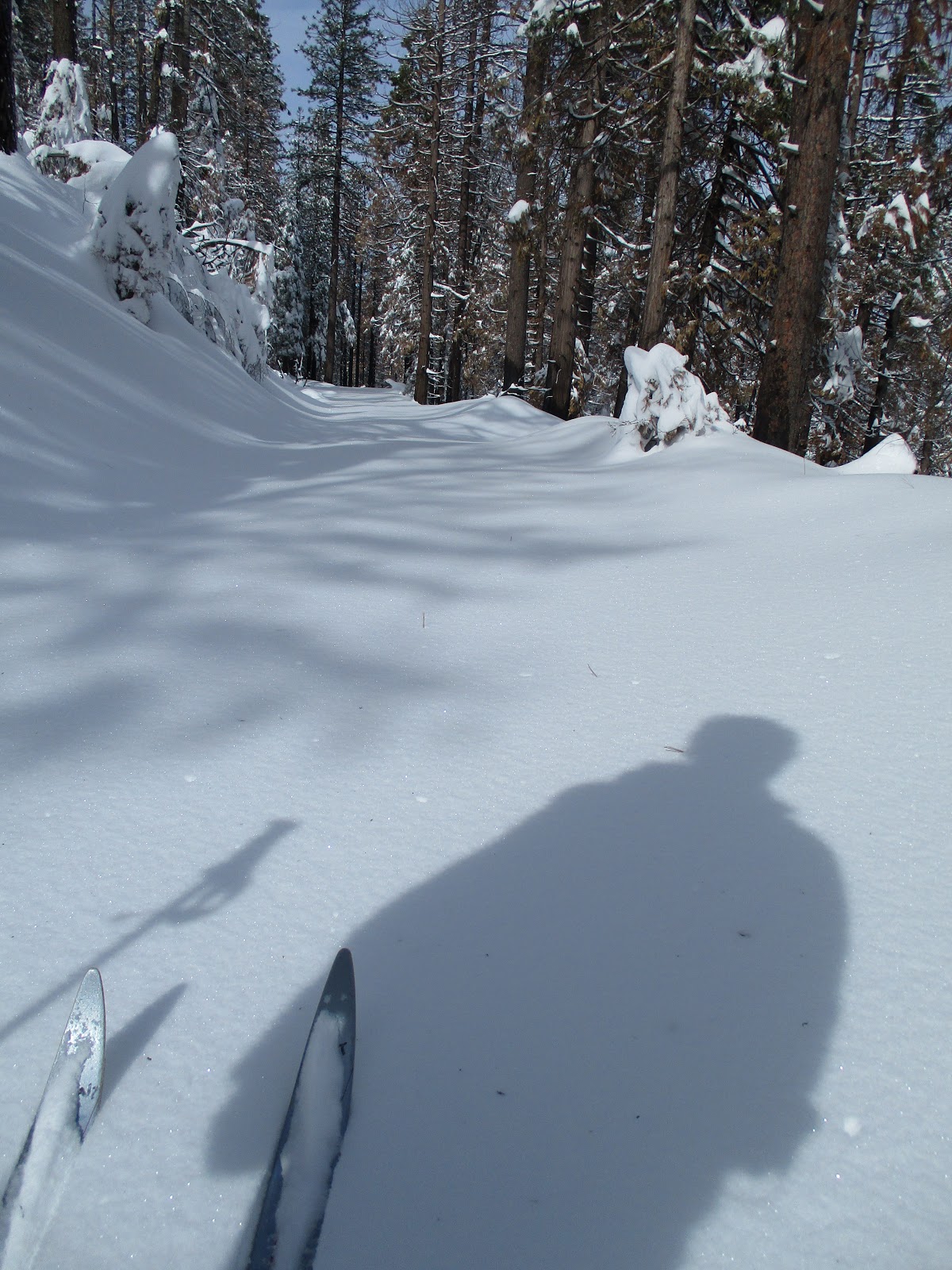
The burned area of last summer's Ferguson Fire (shown here with a skier) has shed a bit of sediment (mostly from the South Fork) in storms but nearly all of that fire was of low intensity and is greening up nicely now. For all the rain and runoff we've had, there wasn't much intense rainfall and we haven't had the rockfalls along Hwy. 140 that we worried about. Not many trees were killed by that fire (lots of already dead trees didn't even burn) and the forest is healthier for it. Burned or not, as with much of California, it's looking like a good wildflower season. Kumlienia started in January, and the rocky banks that were cooked black in August are now coated in greenery and flowers. Poppies, popcorn flower, baby blue-eyes and fiddlenecks are already at photogenic quantities in the Merced Canyon, but are still densifying toward their peaks.

I am again leading trips to Yosemite's sister national parks in China. Mountain Travel Sobek has us headed to explore the natural and cultural history of Jiuzhaigou and Huangshan and to meet with park rangers to learn about China's park management. Hiking in both parks is truly astounding and I can't wait to get back there.

Friday, May 18, 2018

Wet Spring

After another very dry winter, Yosemite has had a bit of recovery with a wet spring. We had warm storms in March and April and are now enjoying a string of about 10 days of cool, cloudy afternoons. The first weekend of April we had the markedly unusual experience of a very late, warm, winter-scale storm. This atmospheric river brought high elevation rain instead of snow, a flood forecast, and a successful pre-emptive evacuation of Yosemite Valley. Sure enough, the Merced River came up through the campgrounds, over the roads, through Housekeeping Camp, and filled the meadows. NPS has nice footage online. There's a persistent myth that these 'Pineapple Express' storms melt a lot of snow, but they really don't. It's the high elevation rain over thousands of acres of bare rock and thin soils that fills the river. This flood event wasn't from a 'monster' rainstorm, just a pretty big storm up high. Lower elevation side streams barely rose, compared to what the river did.

Because of the poor winter and the late-season rains, our springtime runoff peaked a month ahead of normal. The Merced and the waterfalls are already declining in volume, especially with the cloudy conditions we've been having. The clouds are delaying our minimal runoff a bit, which will help waterfalls last and forests to stay watered a bit further into the summer.

The park is still busy felling hazard trees, the small portion of our dead trees that might fall on people/roads/infrastructure. This year's below-average precipitation and above-average warmth will continue to stress Sierra forests (over-thick with trees due to decades of fire suppression) and we'll see more of the weak trees succumb to native bark beetles. Despite changes in Washington, D.C., the NPS in Yosemite is sticking with science and is not dodging the reality of climate change in its training of new rangers. The climate IS changing, it's changing NOW, in ways more rapid than ever, it is because of OUR hydrocarbon use, and it'll have serious consequences for US. It's disappointing that some political leaders think they know more than NASA or the National Academies of Science. Among other things, our fire season is longer, more severe and is costing us all more money to deal with. I'll be heading up to Lyell and Maclure Glaciers with Yosemite Conservancy groups in August and I expect to see those small ice bodies closer to leaving Yosemite entirely glacier-less.

Luckily, because we are causing the current rapid changes in climate, we should have some influence over it. Let's work to reduce our mistake and bring back snowy winters.

Monday, April 3, 2017

Post-winter Recovery

Springtime is making its way uphill in the Sierra with redbud peaking in El Portal now while unfathomable snow persists above 7000 feet. It can hardly be said enough: WHAT a winter we've had here! Storms were repeated with good frequency and lots of Pacific moisture, leaving us with a tremendous snowpack. The snowline was a bit higher than historical averages; not much accumulated in Yosemite Valley (though we had lots of rain runoff), but higher elevations have had fantastical quantities. The central Sierra has 175% of usual water content in the current snowpack. Picture the meadows and forests in the May Lake area buried by 6-7 feet of water (not 6' of snow, but 6' of standing water) - that's the nature of how much mature, dense snow is covering the tens of thousands of acres of Yosemite's upper elevations.

<-Bridalveil in flood.

Storm damage has been considerable in/near the park, with Hwy. 41 having been closed for a month by a washout, and crews working hard to repair slope movement on the Big Oak Flat Road below Crane Flat in hopes of getting it re-opened before Memorial Day. Trails at and above the Yosemite Valley level have a lot of downed trees; trail crew sawyers will be very busy for much of the summer to get those cleared. When you visit the Valley, check out the fragments of bark-less logs below Bridalveil or Yosemite Falls from trees that were uprooted and thrown over the falls this winter. Since December there's been a huge deposit of frazil (wist) ice below Yosemite Falls, and we're now in the month when one is most likely to be able to observe wist ice flowing.

The excitement isn't over. Because of the closure of the Big Oak Flat Road, Hwy. 140 has been handling much more traffic. This past Saturday, visitors were waiting over 2 hours in a 3.5 mile-long line of 800+ cars just to get through the stoplight at the Ferguson rockslide detour west of the park. (Easily avoided by coming in before 9am on weekends.) Because of the road construction in the Valley, the main parking at Yosemite Village will be closed for the next two months, and detours are confusing to both new and veteran visitors. It's going to be a very nice improvement once it's completed, but parking and navigating can be challenges on spring weekends now. Half Dome Village and the new lot by Camp Four are best bets. The road crew is already working to clear Glacier Point Road.

But, wait, there's more. The Merced is running almost 4x average flow today. All that snow in the high country seems likely to bring us some degree of 'high water incident' between now and mid-June (sure to cover some Valley trails at least), depending on how the warming progresses. Yosemite explorers should expect a delayed start to summer, with Tioga Road opening late, trails covered by snow and fallen trees, and creeks difficult to cross.

Saturday, January 7, 2017

High Water 2017

I am quite impressed with NPS preparations for anticipated flooding in the next couple of days; this is much different from the surprises of 1997's flood. Forecasting has been honed and there's institutional memory of the last big one.

As of last evening, all visitors have been evacuated from the Valley. Staff housing in the Half Dome Village area has been evacuated and all other locals are being told to stay put as of tonight. Peak flow is expected late in the day on Sunday. Projections are for about 17,000 cfs at Pohono Bridge, where the Merced exits the Valley. Average river flow for this time of year is about 100 cfs, and because of this week's rain the river is carrying 572 cfs right now. Again, that projection is for the river to increase to 30 times the current flow by tomorrow evening. We had a flood warning in mid-December but the river didn't quite reach 5000 cfs; it needs to get to about 7000 cfs before the water comes up on to a road in the Valley. The river would first gently back up on to pavement at Wosky Pond on Northside Drive.

If we do get to 17,000, this'd make it the 6th biggest recorded volume for the Pohono gauging station. The bigger events were the floods of 1937, 1950, 1955, 1964 and 1997. Five 'big' floods in a century averages to every other decade or so. What some locals parochially call 'The Flood' of twenty years ago was only a little bit bigger than those other four were, and such floods affect far more than just Yosemite. There was no gauging station in 1862, when the Merced surely exceeded its 1997 size in a mega-flood that wrecked the whole state.

All these high water events happen December-February and are due to warm storms, which bring rain to high elevation instead of snow. There's a persistent myth that the 1997 flood was due to rain melting recent snows, but the science says that rain doesn't melt very much snow. The floods happen simply by high snowline causing tens of thousands more acres of watershed to receive rain. Especially in higher terrain with thinner soils and vast expanses of bare granite, that rain just runs off right away and swells the rivers downstream.

I share Muir's enthusiasm for such events; he witnessed and wrote about the flood of December 1871. While I shelter in place, I look forward to seeing the video record collected by the professionals.

Wednesday, August 15, 2012

Heat and monsoon


It's been really hot in Yosemite for the past week, with Yosemite Valley temperatures in the high 90's (but only the high 30's for European visitors...)
While it feels like El Portal could just burst into flame at any moment (it's been up to 110 degrees) the park has been having a surprisingly light fire season to date. The Cascade Fire, east of Crane Flat has been burning quietly for two months now and is still not quite 700 acres. There's a small lightning-caused fire at the top of Vernal Fall and another tiny blaze near Porcupine Flat.
Monsoon moisture that's come in with the heat has made for great cloud shows ("higher Sierras" in Muir's words) recently. You can partake via webcam without threat of hail or lightning. The Merced River has actually doubled in volume in Yosemite, right up to a normal/average flow, because of the upstream rains. A bit of rain fell in Yosemite Valley and west yesterday afternoon - what a pleasant change.
We look forward to the southward migration of birds of prey over the next several weeks. Michael Ross will lead a field seminar on September 8 for those who want to observe this annual phenomenon in the high country.

Tuesday, May 15, 2012

Farewell to Spring


Despite recent warmth, the Merced River has started to decline in volume already; it's running just below average (while the average is still ascending). We are excited to have our new webcam up, showing you Upper Yosemite Falls so you can keep visual tabs on the flows. We expect that by September this year it'll just be the 'Yosemite Wall' webcam.
Indian, Sentinel, Royal Arch and Ribbon Creeks all still run to the river. Eagle Creek has shrunk back from Northside Drive.
The high country along Tioga Road still has snow, lots of soggy trails, no new greenery - it's too early for dry, comfortable hiking that won't leave considerable impacts. People tend to hike outside wet trailbeds, creating new trails and crushing plants as they're trying to get started. Things will be drier in June and it'll be easier to LNT.
Yosemite Valley is alive with birdsong; yesterday's birdwalk included black-headed grosbeaks (plentiful and loud), western tanager, yellow, yellow-rumped, and black-throated gray warblers, Cassin's vireo, white-throated swift, flicker, oriole, Anna's hummingbird displaying in front of the Visitor Center, and more.
In the El Portal area the Clarkia (Farewell-to-Spring) is in bloom, as is buckeye, Ceanothus, and elderberry. Most of the grass and forbs have gone to seed and are browning. The dogwoods in the Valley are glorious right now.
Check out the eclipse of the sun on Sunday at sunset. We were not sure that Yosemite would be a good place from which to observe this spectacle because good western views from places like the Glacier Point Road might not yet be accessible; this year they are. Crane Flat Fire Lookout and Sentinel Dome will be prime spots.
For more enjoyment of the earth sciences: there's still space in our one-day geology course on June 16. Park geologist Greg Stock is a marvelous communicator and will clarify all those questions you have about Yosemite's origins.

Friday, April 20, 2012

It has Sprung


Apologies for the long silence here at a time when so much is happening with the change of seasons in the Sierra.
We had a couple of decent snowstorms last week, now it's very warm.
The Merced River has finally gone to above average volume (at about 1700 cfs overnight at Pohono Bridge) and Table Rock is partly under. Waterfalls are looking quite good. Sentinel, Royal Arch, Eagle and Ribbon Creeks are all flowing into the river. Horsetail trickles into Wosky Pond.
Because our snowpack has less than half of average water content, we don't expect a high runoff this year - very different than last spring. The big melting this week suggests an early peak, too.
Our regular Monday and Thursday birdwalks in Yosemite Valley have turned up lots of singing yellow-rumps and the R2-D2 songs of orioles. Black-throated gray warblers are in, as are black-headed grosbeaks. We haven't seen flycatchers (other than black phoebes) or vireos yet in the Valley, though we know they're nearby.
Flowers in the Merced River Canyon west of the park have been dazzling for the past few weeks: poppies, redbud, birds-eye gilia, caterpillar flower, wallflower, false goldfields, popcorn flower, fiddleneck, cranesbill and dozens of others are still putting on a marvelous show. Buckeyes are green, and the live and deciduous oaks are adding new foliage and dangling their flowers.
Conditions look to be perfect for Dave Wyman's "Spring Light Photography" course, May 17-20. There are a few spot still available; free park entry and free camping are included.
As if we needed one more sign that spring has sprung: Glacier Point Road opens this weekend.

Friday, February 10, 2012

Darwin in Yosemite


"His noble character has suffered from silly, ignorant, and unbelieving men who say much about Darwinism without really knowing anything about it. A more devout and indefatigable seeker after truth than Darwin never lived." -John Muir, 1878.
This Sunday is Charles Darwin's birthday. Muir read and was a fan of Darwin. For context: "On the Origin of Species" came out when Muir was 21 years old (still living with his family in Wisconsin) and 5 years before Yosemite was first protected (with the signature of President Lincoln, who was born the same day that Darwin was!) Muir's writings made it into print while Darwin was still alive, but it's doubtful the British naturalist encountered the Sierra naturalist's tales. These two great individuals are closely joined in perpetuity south of Yosemite where Muir Pass provides access to Evolution Basin and the John Muir Trail runs beneath Mt. Darwin.
Our dry spell continues. We had a day of light drizzle on Tuesday. A few chorus frogs are calling at lower elevation, but they sound parched. Another chance at precipitation comes through on Sunday/Monday. NPS snow surveys show around 30% of average water content for our park watersheds. Elevations below the survey areas are drier yet. The Merced is flowing at 60% of average now. A few common mergansers have been paddling in El Portal, dippers doing a bit of singing.
On Saturday 10 March one of the park's best (and most delightful) naturalists, Karen Amstutz, is leading a fun Conservancy field seminar on snowshoes from Badger Pass out to Dewey Point and back. If you're up for a modestly physical (and extremely pleasant) day of exploration and discovery, think about coming up to join Karen. If you love a Yosemite experience, this one's a natural selection.

Friday, January 20, 2012

Finally wet


After being dry for nearly two months we have a series of storms coming through Yosemite. Light precipitation overnight left snow down below 7000' in places. More accumulation is expected over the next few days, perhaps as much as 2-3 feet at high elevations by Monday.
Tioga Road is closed. Glacier Point Road is closed. But the snow level is high enough that we don't have any chain restrictions in effect. Badger Pass, at 7200' has a ways to go before even cross-country skiing will be possible there.
The Merced River had gone down to 27 cfs at Pohono Bridge - a mere 20% of normal flow! The tiny bit of overnight rain is showing up in the river already with a slight rise. Last night was quite a bit warmer than usual due to the cloud cover that limited radiational cooling. Some of the many frozen waterfalls that have been so visible for the past few weeks are softening up in the warmth and rain.
While Tioga was open, park resources people made some sound recordings of the lake ice on Tenaya, Dog and Lower Cathedral Lakes. If you were up there, you know how eerie those creaking, groaning, pinging sounds were. I hope they'll have some of these unique recordings available online soon.
Meanwhile the dry landscape is soaking up liquid moisture and stacking up the solid form for later use...

Saturday, January 7, 2012

Wither Winter?


I saw a huge scorpion this morning. It was creeping slowly up into the southeastern sky just before dawn: Scorpio, a hint of distant summer. Vega was well up in the northeast- part of the Summer Triangle asterism. It's too close to solstice for these to really be harbingers, but (depending on your horizon; our irregular canyon walls can interfere with the trajectory of change) the sun is rising a bit earlier and setting later than it was a couple weeks ago. Mars and Saturn are also overhead before sunup; Jupiter and Venus after sunset.

The remarkable dry and mild season continues in Yosemite. January snow surveys show a fraction of normal snowpack (13% in the central Sierra) with some sample sites bone dry. Tioga Pass and Glacier Point Roads remain open. It is not true that our ski area is changing its name to "Badger Grass" (photo). While many have observed that this is the latest that Tioga Road has stayed open, others have wondered if instead it's actually the earliest (for next summer) that it's been open to vehicles...
The original road to Tioga Pass was built by hundreds of Chinese laborers. Some of the story of the contributions of non-Anglos to Yosemite is told in this new NPS video. I'm delighted with ranger Chan's research that brings to light more of the details of Yosemite's culturally diverse heritage (and future).
Western Bluebirds are seen at Crane Flat (99% snow-free at 6200'). Great horned owls are calling every night in El Portal, Foresta and the Valley. Chorus frogs are heard here and there, but only individually so far. The Merced River trickles at about 35% of normal flow.

Wednesday, December 7, 2011

Aeolian transition


As did much of the West, Yosemite had a strong windstorm last week. The park had closed the Tioga Road in anticipation of problems and there were indeed numerous lodgepoles felled in the area near the Mono/Parker Pass trailhead (almost at treeline) and a few elsewhere. In Yosemite Valley there were some trees thrown down and many branches flung on Wednesday night. The last of the deciduous leaves were stripped off, though the Cascades area must've been a calmer pocket as there is still color there.
Along the FourMile Trail several large trees were knocked down (photo).
For the first time in many months the Merced River has dropped to below average flow and is as low as it's been in 14 months.
Six species of woodpeckers were observed by my birding group on Saturday, and a seventh just after we split up. Now we await the snows and look forward to getting out in the winter world.
Get up early on Saturday morning to find a spot where you have a good view of a low western horizon. The earth's shadow will eclipse the full moon as the moon sets; you should see it turn reddish-orange as the sky brightens to day.

Friday, October 14, 2011

Foliage change


Rain ten days ago really swelled the Merced River. The historical average flow for last week was below 30 cfs. It had been running closer to 100 cfs, then leapt to over 600 after the rain. That the high country got snow showed in the nice 24-hour cycle of melt ebb and flow shortly after the storm. Our waterfalls are again looking exceptional for this time of year.
Ladybird beetles are on the move in this warm (moist) weather, with many swarming in El Portal the past couple of days.
A red-shouldered hawk, and a pair of great horned owls were heard in the volunteer campground in Yosemite Valley. A Say's phoebe was seen in Rancheria Flat.
Orion and Canis Major dominate the morning skies if you're out early and have a view to the south.
The sugar maple in old Yosemite Village has just started to show a tiny touch of color. At the Valley elevation, other than dogbane and some bracken, most color has not yet appeared. Alders skip the show and just start dropping their green leaves into the river when they're done, which is now.
Higher up you'll find aspen and bilberry being more colorful now. It should be a good weekend for getting out in the park.
Half Dome cables are down for the winter, Backpackers, Yosemite Creek and Crane Flat Campgrounds are closed for the season now.

Tuesday, September 20, 2011

Equinox approach


Autumnal equinox arrives Friday, then it's already October at the end of next week. We had 5 days of afternoon monsoons a week ago, a fun change of season, but summer's heat is not done yet. Mts. Dana and Gibbs were quite snow-covered a week ago; Conness is pictured. Hail had piled up at the 8000' level along Tioga Road. A cloudburst in Yosemite Valley left big puddles that haven't evaporated yet, and lots of runoff debris in small channels everywhere. A torrent coming down the Indian Creek fan went into some NPS houses at the edge of Yosemite Creek. The river gauge shows nice spikes from the series of rainy afternoons.
As it has been for most of the past 9 months, the Merced is running above average: at 129 cfs this morning; the average is 32 cfs for today. Yosemite Falls looks like it does in some Julys; not big, but much more than the usual September dribble.
Lessingia's purple blooms on the Valley floor are even visible from Glacier Point. Bears are still finding ripe apples on trees (lots at McAuley Ranch) but it's a weak mast year for acorns in some spots. Migrating raptors are being seen regularly now. A ring-necked snake was seen near Foresta on the weekend.
Another Half Dome fatality yesterday; this time a climber whose rope broke after he pulled a block onto it. Crowds are absent from the Valley most days, though weekends are still relatively busy. Our visitors from other countries stand out more now.

Thursday, August 25, 2011

Founders Day


The National Park Service was established on this date in 1916, and today's Director is announcing big plans to prepare for celebrating the centennial in 5 years. In Yosemite we are also planning diverse ways to observe the sesquicentennial of the Yosemite Grant in 2014. This was when the US government protected Mariposa Grove and Yosemite Valley (yes, 8 years before Yellowstone).
There was yet another regretable fatality in the park early this week, when a hiker fell from the top of Half Dome, down the face. No official story for how this happened has been released.
Some of us woke to an earthquake yesterday (24 August). After anomalous quakes in the prairie of southern Colorado then near Washington, D.C. in recent days, it was a little more exciting to hear the ground roar then feel it tremble for a moment here. Our event was from a 4.2 shaker, over near Mammoth Lakes on the East Side at 5 a.m. The hypocenter was 10 km beneath the Sierra, between the crest and Mt. Morrison.
The Merced River is low, but not as low as it usually is at the end of August. Yosemite Falls is still relatively impressive - far more people are taking photographs of it than ever do in typical August. Squirrels are shredding ponderosa cones. Bears are finding ripening apples, and though the eat pounds of them, their scat appears to leave a lot of calories untouched.

Wednesday, August 10, 2011

Smoke and Heat


The Avalanche Fire is putting up a good amount of smoke from just above the western end of the Glacier Point Road and it finally feels like summer in the Sierra. This fire was caused by lightning and is just over 400 acres. It's burning at ground level in a healthy way and managers hope it'll burn at least 2000 acres.
The river and waterfalls are still running at unusually high levels, approximately 4-5 times the trickling volumes normally seen in early August. Yosemite Falls is still worth a photograph and Vernal is still all the way across the lip, and putting lots of mist on to the Mist Trail.
Birdlife has quieted considerably in Yosemite Valley. Orioles and grosbeaks are still around, but they are silent. Mule deer bucks have full, velvety racks now.
Coneflower, some tincture plant, lotus and milkweed are in bloom in the Valley - it's a great year for floral displays. The show has shifted to higher elevations where pentstemon, gentians and others are blossoming. Post-bloom, our native raspberries are ready for harvest in the Valley. Yum!

Thursday, July 14, 2011

Summer Still Coming


Blazing stars and Clarkia are still in bloom in El Portal, buckeye flowers are gone and leaves are browning. Yosemite Valley has spicebush, cow parsnip, Draperia, Gray's lupine and azalea in bloom. Birds have gotten quiet, ducklings and merglets are nearly full grown. The Merced River is still running at 400% of normal flow for mid-July, but the top of Table Rock is partly above water and the Valley has been opened to rafting/floating.
Utilities challenges persist in Tuolumne Meadows, but NPS hopes to activate the septic and water systems tomorrow. If they work this means that employees can move in up there and that facilities can open up. The campground is supposed to open Friday night, the Visitor Center should open Saturday and the Tuolumne Meadows Lodge plans to open on Monday the 18th. It'll be a short season, with many facilities starting to shut down after Labor Day, in just 7-8 weeks.
Flowers are pretty good at the 7-8000' level now, with bright Sierra pride pentstemon lighting up the roadcuts. Lots of snow and high water persist along Tuolumne trails. Hikers should plan on covering fewer miles than on dry ground. The waterfalls in the Valley are still quite impressive.